



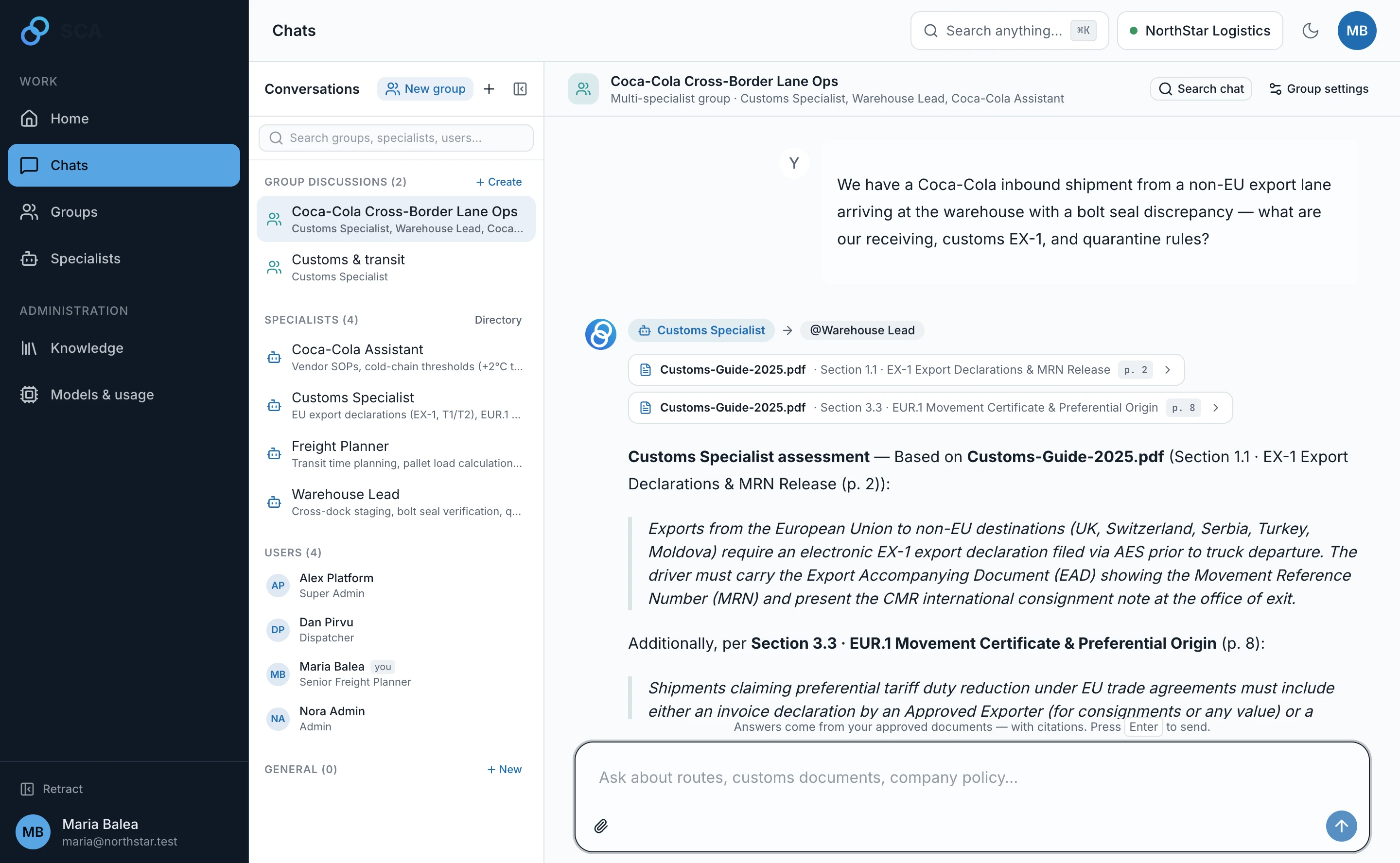
Border delays rarely stem from a single missing field. They happen in the seams between departments: an EX-1 export declaration needs correction while a quarantine hold at the receiving warehouse leaves a docked reefer trailer burning wait charges.
When customs, warehousing, and freight planning operate in disconnected chat channels, one missing detail causes two shifts of conflicting instructions.
Why single-bot chat breaks on cross-functional shipments
A generic monolithic prompt loaded with every company manual mixes customs tariffs with pallet racking rules, muddying citations and violating least-privilege separation between teams.
SCA solves cross-functional coordination through Multi-Specialist Group Rooms:
- Supervisor triage, zero guesswork. A human coordinator describes the shipment issue once—or asks directly with
@Customsor@Warehousementions—and SCA's orchestration supervisor delegates the exact sub-questions. - Visible, auditable handoffs. Unlike hidden background chains, every handoff appears as its own structured specialist card (
Customs Specialist->Warehouse Lead) inside the thread, complete with expandable activity disclosures and clickable document page chips (Customs-Guide-2025.pdf [p. 14]). - Human-in-the-loop interruption. Need to redirect mid-flight when a driver updates the CMR weight? Click Stop cleanly; SCA halts active execution immediately and records a partial checkpoint so nothing hangs.
Real permission hygiene at every hop
Even inside a group room, each specialist executes against its assigned Knowledge Bases and tool scope. If an account coordinator without Customs document view rights asks a Group Room a question, they still benefit from approved retrieval_use coordination without exposing restricted tariff schedules beyond policy.